B. Galaxy
B.1 Galaxy In Universe
In a universe of thousands of galaxies spread with a very large distance and large respectively as well. Our galaxy, which is where our sun as a member, called the Milky Way. In English is called Milky Way. The diameter of the Milky Way galaxy 80,000 light years away (one light second = 300,000 km, which means that light propagating in one second and a distance of 300,000 km). The nearest galaxy with the Milky Way is the Magellan Clouds (Magellanic Clouds). The distance that the two galaxy light 160,000 years. In the universe there are thousands of galaxies spread. May the Lord step that the All-Knowing, how vast the universe.
By mapping the haze of gas and bright main sequence stars (O stars and B) and by observing the direction and motion of a large number of O and B stars, as well as the distribution of rotational motion of the nebula and galaxies at various distances from its center, it can be concluded that the distribution of stars in we are a large disc-shaped galaxy that contains flattened about 100,000 light-years away and the sun is about 30,000 light years from the galactic center. Lamellar structure of this galaxy is caused by rotational motion and the sun moves around the center of our galaxy with a speed of 250 km / s and with a period 200 million years.
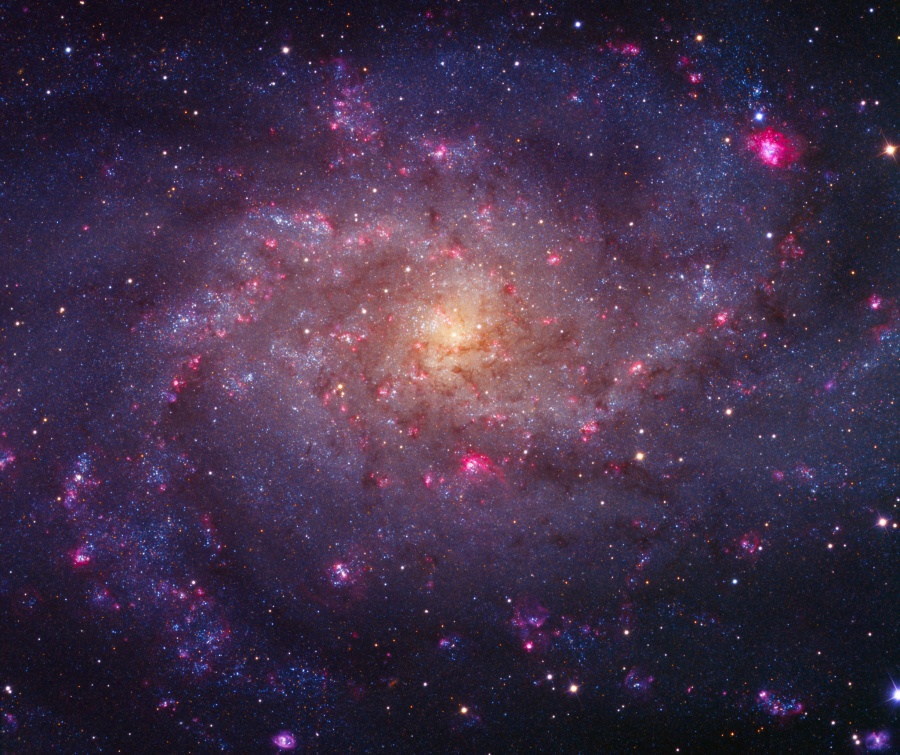
The main part of the galaxy composed of stars that form a relatively flat disc with cembungan at its center called the nucleus of the galaxy. The stars in this galaxy's core distance is close to one another. Extends out from the core there is disk like a spiral galaxy that churned out from the galactic core called the spiral arms. Figure 1 shows a chart of the Milky Way galaxy 100,000 light-years in diameter and the sun is at one of the spiral arms in the position of 30 000 light years from the galactic center.Spiral arm is made up of cosmic clouds of gas and dust that many called the interstellar medium. Along with gas and dust clouds have a lot of young stars, some of which are very hot and very bright. In a cloud of interstellar gas and dust in spiral arms is still the formation of new stars.
Besides, the galaxy contains numerous star clusters (star cluster), a group of stars that may have the same origin and age. There are two types of star clusters namely open clusters and globular clusters. The most common and the number of thousands is an open group or also with a group called galaktika, which usually consists of several hundred stars that are not so strongly bound together by gravity in space. Open cluster is located on the main disk galaxy and usually located in or near spiral arms. Globular clusters form a system of hundreds of speroidal layering this dish, and each cluster contains hundreds of thousands of stars. Besides that there are not any stars to be members of the group, but the number far exceeds the star cluster and the entire region is at the star cluster. Any stars and star clusters form a so-called halo galaktika. Hello This volume covers an area which exceeds several times larger than the main disk galaxy. Galaktika radio emission suggests that the halo contains gas, and the x-ray radiation from the gas. This indicates that the gas is very hot in the order of 106 K. This hot gas extends only to the inside of this halo called the corona and galactic.
The closer towards the galactic core, especially near the middle core cembungan disk galaxies, stars and star clusters of the halo is more tightly than in areas far from the galactic core. Halo has a thickness of at least 100 000 TC, and even in the direction of the galactic plane in diameter can be up to two or three hundred thousand light years, and extends far beyond the circumference of the main disk galaxy. among the stars of its members.

Figure 1. Part Milky Way with the sun at one point.




 RSS Feed (xml)

